For years, marketers and communications professionals have lived by a familiar principle: if you’re not ranking first, there are still gains to be found.
A brand might appear down the page of search results and still generate meaningful traffic and awareness. Visibility wasn’t a case of all or nothing, users could browse, compare sources, and continue searching until they found what they needed but AI search is changing that dynamic.
As AI-generated answers become more prevalent across search and discovery platforms, visibility is becoming increasingly concentrated among a much smaller group of brands. In many cases, users are no longer presented with dozens of options. Instead, they receive a single synthesized answer, often supported by only a handful of sources. For brands, that creates a new reality – there is no second page.
Search Is Becoming an Answer Engine
Traditional search engines were designed to help users navigate the sprawling web, but AI-powered search tools are designed to reduce that navigation altogether.
Rather than presenting a list of links, AI systems increasingly aim to provide the answer immediately. Whether the question relates to technology suppliers, market leaders, emerging trends, or product comparisons, users are often presented with a concise response that removes the need for further exploration. From a user perspective, this creates a faster and more convenient experience but from a visibility perspective, it dramatically narrows the field.

The New Visibility Gap
In traditional search, visibility existed on a spectrum with a brand ranking in lower positions still having a chance of attracting attention. Appearing on page two of search was far from ideal, but it wasn’t invisible. AI-generated search introduces a much sharper divide – with a small number of brands referenced directly there is intense competition for what remains. This creates a widening visibility gap between brands that are consistently surfaced and those that are not.
The brands most frequently cited become increasingly familiar to audiences, analysts, journalists, and decision-makers. Their authority grows as they are repeatedly associated with important industry conversations. Meanwhile, brands that fail to appear risk becoming absent from the discussions shaping their markets and losing relevance.
Visibility Starts with Accessibility
As visibility becomes increasingly concentrated, brands need to think carefully about how their information is discovered, accessed and referenced. That applies not only to customers and stakeholders, but also to journalists, analysts and the wider ecosystem of sources that influence how industries are understood.
For many communications teams, this is driving renewed investment in newsroom infrastructure that makes company information, assets, expertise and supporting evidence easier to find and use. Ite easier it is for trusted third parties to access accurate information, the greater the opportunity to be included in the conversations shaping a category.
Why This Matters in Complex Industries
The effects of compressed visibility are particularly pronounced in markets where buyers conduct extensive research before making decisions. Prospective customers increasingly use AI tools to accelerate research and when those tools consistently surface the same brands, perceptions of market leadership can quickly become reinforced.
Brands do not necessarily need to be the largest player in a category to become associated with leadership, they simply need to be among those repeatedly included in the conversations AI systems summarise.
The Compounding Effect of Inclusion
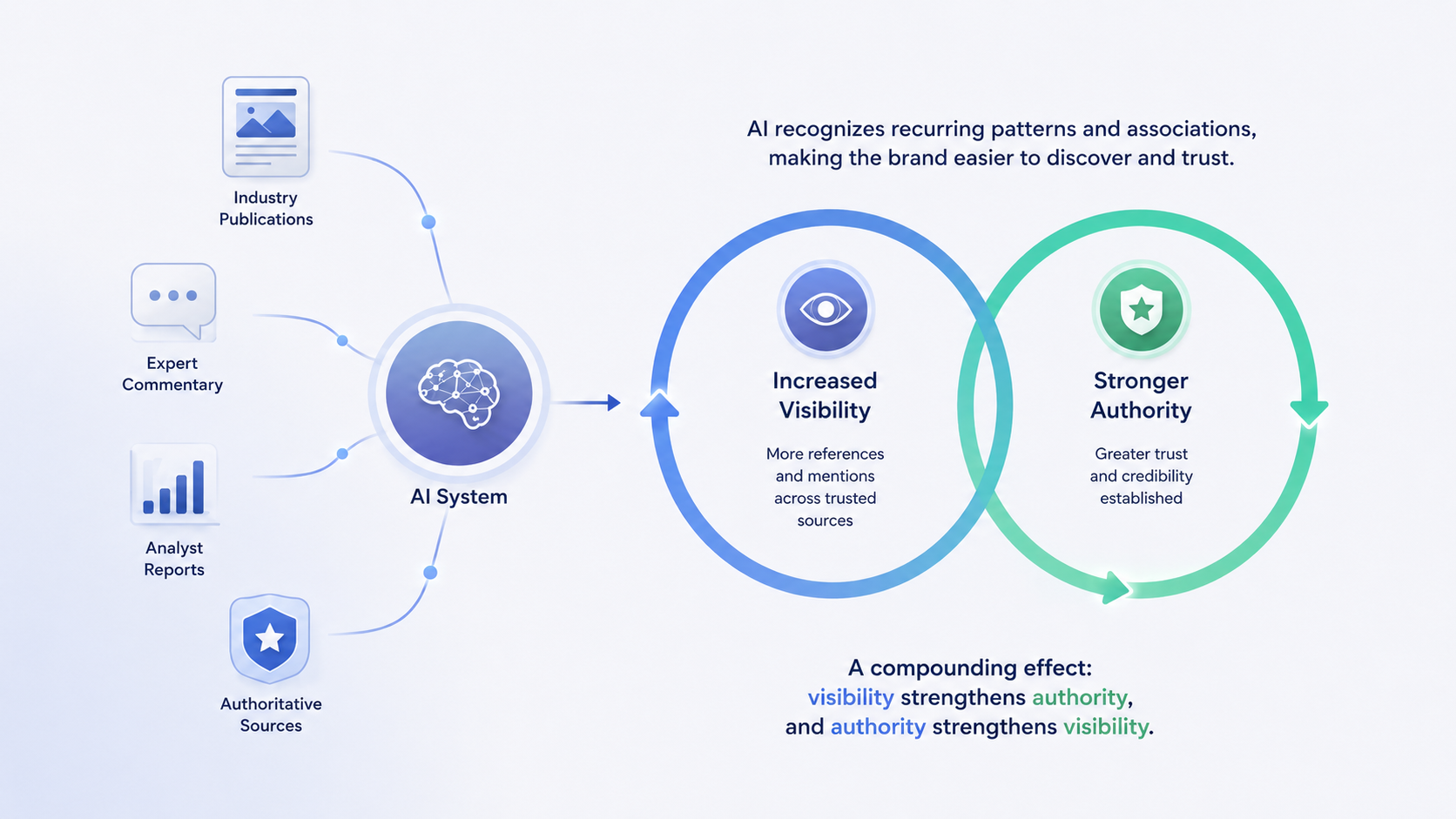
One of the most significant characteristics of AI-driven discovery is that success can become self-reinforcing. When a brand is frequently referenced across industry publications, expert commentary, analyst reports and authoritative sources, it becomes easier for AI systems to identify recurring patterns and associations.
The result is a compounding effect in which visibility strengthens authority, and authority strengthens visibility.
Rethinking Communications Strategy
For communications leaders, this shift requires a broader view of what visibility means – success can no longer be measured solely by website traffic, impressions, or media volume.
Increasingly, brands need to consider how they are represented within the wider information ecosystem.
Key questions include:
- Are we consistently associated with the themes that matter to our customers?
- Are independent sources reinforcing our positioning?
- Are our proof points being repeated across trusted publications?
- Are we visible in conversations shaping our category?
The answers to these questions may have a growing influence on how AI systems understand and represent a brand.
Building for Inclusion
The emergence of AI search does not change the core fundamentals of robust communications, but what has changed is the potential consequence of being overlooked. As visibility becomes increasingly concentrated, brands cannot rely on simply publishing more content or improving rankings. They must focus on earning a place within the broader narratives that define their industries. That means investing in authoritative coverage, strengthening relationships with trusted media, providing journalists with access to accurate and usable information, and maintaining consistent positioning over time.
In an environment where AI increasingly decides which voices are amplified, the objective is no longer to appear somewhere in the results – it is to be part of the answer.
Want to make your brand easier for journalists, stakeholders and AI search to find? Click below to send your information